
■ RESEARCH AREA
Super Intelligence (SI)Virtual Reality
Hyper Reality Multimedia Communications Cyberspace Share Technology OpenSocial API(Ex:Social Networking Services) Abstract "Cloud Computing" has increasingly become a term that people are concerned about, because it represents the future of the information age. So, what is Cloud Computing ? What is the use of Cloud Computing? How will it change the world? Many issues remain to be answered. Although many issues are now may not yet have complete answers, this article tries to analyze the origin of Cloud Computing and the relationship between Cloud Computing and grid computing, Web 2.0, and ubiquitous computing in order to illustrate the history, development and future of Cloud Computing. The first scholarly use of the term “Cloud Computing” was in a 1997 lecture by Ramnath Chellappa. In 1983, Sun Microsystems declared, "The Network is the Computer".Until around 2006, the word "Cloud Computing" began to appear occasionally in the media magazines. In March 2006, Amazon released the Elastic Compute Cloud — EC2 service. August 9, 2006, Google Chief Executive Officer Eric Schmidt first proposed the concept of Cloud Computing at the Search Engine Conference (SES San Jose 2006). By the end of 2007, the frequency of "Cloud Computing" is increasing rapidly. Google and IBM promoted a Cloud Computing project on U.S. college campuses, including Carnegie Mellon University, MIT, Stanford University, the University of California at Berkeley and the University of Maryland, etc. IBM and Google, two companies each to contribute 2000 to 2500 million U.S. dollars. provided approximately 400 advanced computers, and planed to eventually place a total of more than 4,000 computer units. These computers were connected with six universities, including the Universities of Washington in Seattle, the University took part as the lead research and development programming. This project hoped to reduce the cost of distributed computing technology in academic research and to provide relevant software, hardware equipment, and technical support for these universities (Including hundreds of personal computers and BladeCenter and System X servers, these computing platforms would provide 1,600 processors and support open-source platforms including Linux, Xen, Hadoop, and others). Students could develop the web-based large-scale computing research projects. In early 2008, Cloud Computing in the Chinese language began to be translated as “云计算”or“曇端計算”.(1)Source of Cloud Computing - Amazon EC2 product In fact, EC2 product was launched earlier than IBM's and Google's. Although Amazon EC2 is a heavyweight product in the Cloud Computing market, but in 2006 and 2007, Amazon's own influence is very limited in the world. So Amazon's EC2 cloud product contributed less to the popularity of the concept than the IBM–Google project did. But this does not prevent EC2 from holding a pioneer status in Cloud Computing in the world. Although Amazon made little contribution to the popularity of the concept of Cloud Computing in its early development, with the development of Cloud Computing, Amazon's strength and level in the Cloud Computing field have been higher than IBM's and Google's from the beginning. In August 2006, Amazon released the Beta version of the EC2 product, having previously published another important product, S3. EC2 is an abbreviation of Elastic Compute Cloud. S3 means Simple Storage Service. At the time of its release, EC2 was called Simple Compute Service, not as a category name, but as a product name that introduced "Cloud" as an alternative service concept. Of course, calling it Elastic Compute Cloud Computing is clearly inappropriate. The original reports on the EC2 product launch, including one titled "Amazon Cloud Computing Goes Beta," mostly described it as Utility, Elastic, and Virtualized. In October 2007, with IBM and Google presenting some of their projects as Cloud Computing, Cloud Computing began to spread rapidly (within a limited IT circle). At that time, IBM's and Google's parallel computing project was still for research and scientific purposes, while customers found that EC2 was a very commercial Cloud Computing product. As Amazon's AWS products include a lot of Cloud Computing services, this also established Amazon's position as a Cloud Computing market leader. Big Data
(2) Definition of Cloud Computing Cloud Computing is a very cool web application model. The proposal of this concept overturned the traditional concept of the Internet world. In a narrow sense, Cloud Computing refers to IT infrastructure delivery and usage patterns, where resources are obtained on demand over the network in a scalable manner. In a generalized sense, Cloud Computing refers to the mode of service delivery and use — a means to obtain the necessary expanded services on demand through the network in an easy way. This service can be IT and software, Internet-related, or any other services; it has a very large scale, virtualization, security, and reliable unique effects.

(3)Timeline for History of Cloud Computing

1983	Sun Microsystems,Inc,.Founded
1994	Amazon.com Establishment
1995	Yahoo! Inc. Founded
1998	Google Search Founded
1999	Salesforce.com Founded
2001	IBM,Grid announced its Grid
2005	Article by Dr. Tim O'Reilly "What Is Web2.0?" released
2006	Amazon S3  Started
	        Google CEO Eric Schmidt mentioned 'Cloud' as a keyword
	        Twitter Started
	        Amazon EC2  Started
2007	Microsoft SkyDrive Started
	        Google, IBM and a number of universities embarked on
                a large scale Cloud Computing research project
2008	Microsoft Windows Azure (Ray Ozzie — Chief Software Architect of Microsoft)
	        Google App Engine

2009	Oracle's acquisition of Sun Corporation
	        Xerox acquisition of Affiliated Computer Services
2010	More launched(Salesforce.com and Mare jointly launched
                More Services)
	        Oracle Exalogic Elastic Cloud


2. The Advantages of Cloud Computing
(1) Lower Cost
This is a quantitative financial advantage: You do not need a high-performance
personal computer (which corresponds to a high price) to run Web-based cloud
applications. Because all of the applications and operations are in the cloud, not on
your personal computer, you do not need to install the operating system software of
a traditional personal computer (such as Microsoft Windows, Unix, etc.),
and you certainly do not need hard disk space for storage. Therefore, a Cloud Computing
client computer can be cheap, with a smaller hard drive, less memory,
and more efficient processors. In fact, the client computer does not even need a CD
or DVD drive in this case, because it does not load software programs
and does not need to save any documents.

(2) Higher Performance
Using Cloud Computing means you do not need to store and run PC-based software applications;
there are no cumbersome procedures taking up computer memory, so computer users will
get better performance. In short, a cloud computing system starts up and runs faster than
a personal computer, because it only loads small programs and processes into memory.

(3) Lower IT Infrastructure Costs
In larger organizations, through the use of the cloud computing model,
IT departments can reduce costs. There is no need to invest in more powerful servers;
IT staff can use Cloud Computing capabilities to supplement or replace internal computing resources.
Companies with peak traffic needs no longer need to purchase equipment to respond to
peaks (which would sit idle the rest of the time); by using computers and servers in the cloud,
peak computing needs will be met easily.

(4) Less Maintenance or Management
From the viewpoint of maintenance costs, no matter what size a company is, Cloud Computing has
greatly reduced the maintenance costs of hardware and software. The first is hardware.
As the organization requires less hardware (fewer servers), maintenance costs
decrease immediately. The second is software maintenance.
We know that all cloud-based applications are located elsewhere,
so the organization's computers have no software, and therefore there is
no need for unnecessary IT engineers or staff to maintain them.

(5) Lower Software Costs
Cloud Computing's most attractive advantage is the cost of software.
There is no need to purchase a software package for each computer in the organization,
and only those employees who actually use the applications need to
access applications in the cloud. Even when using Web-based applications similar
to desktop software, the cost will be much lower than buying the software now
(for example, buying Microsoft software). IT personnel save the cost of installing
and maintaining these programs on each desktop.

In fact, many companies now offer very low-cost or even free services.
These companies (such as Google) are free to provide their Web-based applications.
It is more attractive to individuals or large enterprises than spending high prices to
buy Microsoft software or similar desktop software and applications from vendors.

(6) Real-Time Updates for Software
Another Cloud Computing software-related advantage is that users no longer
worry about software upgrades and paying high costs. For Web-based applications,
updates happen automatically, and users work on the cloud the next time they log on.
Moreover, whenever you visit a fee-based Web application, you always use the latest
updated version, without having to pay fees or download updates.

(7) Enhanced Computing Power
This is obvious. When you connect to a Cloud Computing system, you can freely dominate
the power of the whole cloud. You are no longer limited to what a single computer can do;
using thousands of computers and servers' capacity, you can perform tasks like supercomputing.
In other words, in the cloud, you can try a bigger task than on a traditional desktop.

(8) Unlimited Storage Capacity
Cloud Computing provides almost unlimited storage capacity. Imagine your desktop
or notebook computer is about to run out of storage space. The cloud can be used with
hundreds of PB (100 million gigabytes) of capacity, compared to your computer's 200GB
hard drive. That's so insignificant. Whether you need to save something,
you have enough space.

(9) Enhanced Data Security
All your data is stored in the cloud, isn't it? It has been somewhere in the cloud.
This is different compared with the traditional desktop environment. In the past,
when your computer hard drive crashed in the desktop environment,
it would destroy all your valuable data.

But a Cloud Computer crash will not affect your data storage, because the cloud data
is automatically copied, so there will never be any loss. This also means that
even if your PC crashes, all your data is still stored in the cloud and you can still access it.
In the desktop world, few users regularly back up their data.
Cloud Computing can guarantee or maintain the security of data.

(10) Improved Compatibility Between Operating Systems
Have you ever tried to make a Mac communicate with a Windows-based system?
Or let a Linux machine share data with a Windows computer? I believe you will hate this process.
Using Cloud Computing, this is not necessary; in the cloud, the operating system is not
important. You can connect your Windows computer to the cloud, and run Apple Mac OS, Linux,
or UNIX computers to share files. In the cloud, the important thing is the data,
not the operating system.

(11) Improved File Format Compatibility
Using Cloud Computing, you do not worry about whether your machine is compatible with
documents created in another user's application or operating system.
(For example: a Word 2007 document cannot be opened by Word 2003.)
Web-based applications of cloud computing can be compatible with all file formats
created by all users. When everyone shares data or applications in the cloud,
the problem of format incompatibility no longer exists.

(12) Easier Group Collaboration
Working together for many users, so multiple users can successfully work together
on common projects online. That function of computers is one of the most important
advantages at present. Just imagine, there is an important development project
between China and Japan, and they need to immediately communicate face to face to
solve development problems. Before the appearance of Cloud Computing,
you had to send the relevant documents from one user to another member by email.
Today, if you use Cloud Computing, it is unnecessary to do so.
You can access project documentation with each other in real time; when a user
edits content, it can be automatically reflected on other users' screens.
This is of course entirely possible, because the documentation is in the cloud
and not on the personal computer. All you need is a computer with an Internet
connection, and then you will be able to collaborate.

Of course, the majority of group collaboration means faster completion of larger projects.
It also makes group projects possible across different geographic locations.
Groups no longer must stay in the same office in order to have a better result.
And with the use of Cloud Computing, anybody,
any low (regardless of your identity and status) can collaborate in real time.

(13) Universal Access to Documents
For example, on holiday at your own home, you suddenly think of forgetting
important files at school. Or you go to a computer center at school and just
forgot important data. That's no problem; with Cloud Computing,
you do not have to carry documents. Instead, as long as you have a computer
and Internet access, you can access them from anywhere. And no matter where you are,
all of your documents are ready for use. Therefore, there is no need to carry documents —
as long as you can connect to the Internet, simple as that.

(14) Eliminates Reliance on Specific Equipment
Finally, here is the ultimate advantage of cloud computing. You are no longer dependent on
a single computer or network. When replacing a computer, with the cloud, existing applications
and documentation will follow you. Switch to a portable device, and your applications and
documentation are still available. There is no need to purchase special equipment for
a specific version of the program, or a device-specific format for your document.
No matter what kind of computer you use, your documents and the procedures
that create them are the same.

6. The Future of Cloud Computing
"640K ought to be enough for anybody."
Source: http://en.wikiquote.org/wiki/Bill_Gates

Bill Gates, 1989, talking about "computer science in the past, present, and future."
It is well known that programs were very small in the late 1980s, and a 100MB hard disk
was almost used up. At that time, the Internet had begun to develop,
but it had not yet been widely available and popular in the world. Meanwhile,
the era of digital cameras, digital music, and 3D movies had almost not arrived.
Therefore, storage space requirements cannot be compared with today's level.
This was a mistaken judgment about the future of the IT industry by Bill Gates.
That judgment led Microsoft to be concerned only with software development,
while ignoring the Internet.

Today, the common standard computer users need is: low-end Core Duo — 1GB,
hard drive memory size — 100GB, and soon the MB-level hard disk drive will enter family use.
With the rapid development of Internet technology, many things are easily solved by the Internet,
such as watching TV online, listening to music, writing reports, storing travel photos,
sharing new ideas, and so on. As time goes by, we gradually find our favorite experiences —
movies, music, pictures — and always try to collect and save them for later reuse.
Now, with cloud storage, you can freely store all the material
according to your needs.

Cloud Computing is considered the next revolution in the science and technology industry;
it will bring a fundamental change in working methods and business models.
First, Cloud Computing means great business opportunities for small
and medium enterprises (SMEs); they can make use of Cloud Computing at a higher level,
and as a platform compete with large companies.

Since 1989, when Microsoft launched the Office business software, the way we work has
undergone great changes. Today, Cloud Computing technology has revolutionized the world of
Microsoft's monopoly situation. Because Cloud Computing is bringing cloud Office,
it has more computing power, and there is no need to buy software, without having to
install and maintain it on a local computer.

Secondly, Cloud Computing means the end of hardware. At least, small and  medium
enterprises (SMEs) no longer need to buy expensive hardware to compute for increasing demand;
instead, they just rent Cloud Computing from vendors, thus avoiding large investments
in hardware costs. Meanwhile, the company's technical department is also not required to
bear the headache of technical maintenance, and they can save a lot of time for
more business innovation and creation.

Take Amazon for example: its Cloud Computing products are cheaper (of course profitable),
attracting a large number of small and medium enterprises, or even "The New York Times,"
Red Hat, Scandisk, and other large companies to join. Amazon provides 1GB storage for 15 cents,
and the server lease is 10 cents an hour. Allegedly, its "cloud" investment is only $300 per computer.
If power consumption is 300 U.S. dollars, Amazon's earnings are $876 calculated according to
the charges in the case of an uninterrupted year. The profit margin is about 45% —
higher than the gross sales of books.

With the rapid development of Cloud Computing, traditional hardware manufacturers
have to face crisis once again. Dell, HP, SUN, and other companies worry about the U.S.
market having been declining; perhaps the decline of the hardware market is really coming.

Cloud Computing's impact on the business model is mainly reflected in the market space of innovation.
Harvard Business School professor Christensen believes that Cloud Computing means a return to
the mainframe era from the PC era. In the PC era, PCs offer a lot of good applications and functions;
now we are back to the mainframe era. Now the mainframe can never be seen or touched,
but it is true that the mainframe is put in there, and them in the clouds.

(1) Future Prospects
Imagine what happens when the computer's computing power is no longer limited by local hardware:
smaller size, lighter weight, able to handle more powerful mobile devices. We are fully capable
of using a notebook as paper-thin and light, but it still runs the most demanding online games,
and can access the Photoshop application and edit photos through the mobile phone online.

More attractive, companies can get very high computing power by low-cost investment,
no longer need to purchase expensive hardware, and without having the burden of
frequent maintenance and upgrades for your terminal equipment.

For example, the real estate corporation (Gossipy) wants to create a database to
calculate 670,000 families' acquired property data in 12 years, in order to provide consumers
with better proposals. If they construct everything from hardware to software by themselves,
initial estimates suggest it takes 6 months and one million dollars to achieve this goal.

In the end, they chose Amazon's "Elastic Computer Cloud" service.
Using powerful data analysis capabilities by Amazon, completion of the project was only 3 weeks,
costs less than 5 million. This is the charm and power of Cloud Computing.
That is, the calculation of distribution according to need gives full play to
the performance of large-scale computer clusters. If you only use 5% of the resources,
you just pay 5% of the price; you do not need to pay 100% for the equipment as in the past.

(2) Standards of Cloud Computing
On the standard of Cloud Computing, companies are concerned about their standards,
including Amazon, IBM, Microsoft, Sun, and other IT giant corporations.
The benefits of entering the market as early as possible are obvious: to win a good
public relations image and attract the attention of academia and industry,
through continuous development of new technology to push the cloud computing market.
More importantly, Cloud Computing is considered the user's key step from the desktop into
the Internet; whoever wins the battle will win the rule-making power at a critical period of
changing the rules.

Therefore it is not difficult to understand why Amazon and Sun are so actively joining
in this competition. In 2007, Amazon opened up "Flexible Cloud Computing" service to developers,
so small software companies can buy the processing power of Amazon data centers.
So small software companies can buy data space according to the company's needs.
Sun introduced the "black box" program. The program is based on cloud theory,
saying that the future data center will no longer be confined to crowded and stuffy rooms,
but will be a removable container; companies can move it to the "suburbs,"
including a variety of places, in order to reduce room costs.

Microsoft and Google are the most important players in this race.
As we all know, Google has been trying to provide more computing power and services
for users through the Internet, in order to subvert Microsoft's desktop monopoly.
Google promotes its cloud computing platform as a form of open source, which means that users
can get the platform code and modify it. This is regarded as a favorable way to promote Cloud Computing.
Eric Schmidt believed that "90% of the computing tasks can be completed through Cloud Computing."

It is obvious that the major companies are carving up the big cake of Cloud Computing.
However, we believe that the ultimate beneficiary is the users; Cloud Computing will take us
into a new world, and truly change our lifestyle in the future.


MORE INFORMATION >>>>

--------------------------------------------------

References:
(1) http://en.wikipedia.org/wiki/Cloud_computing
(2)Michael Miller, 《Cloud ComputingWeb-Based
Application that Change the Way You Work and
Collaborate Online 》China Machine Press,
May 2010.PP: 12-15
(3)John W.Rittinghouse,James F.Ransome
《Cloud Computing –Implementation,Management,Security》
China machine press,2010.05 .charpter 7,p124.
(4)http://gihyo.jp/design/serial/01/tcloud/0004
(5) http://en.wikiquote.org/wiki/Bill_Gates
(6)http://www.netvalley.com/archives/mirrors/davemarsh
-timeline-1.htm
(7) http://www.slideshare.net/DSPIP/cloud-computing-
introduction-2978287
(8)http://www.cioinsight.com/c/a/Strategic-Tech/Cloud-
Computing-Anything-as-a-Service/
(9) http://itknowledgeexchange.techtarget.com/data-
center-facilities/tag/google-data-center/
(10) http://www.focus.com/articles/hosting-bandwidth/
top-10-cloud-computing-trends/
(11)Yang Wenzhi《Cloud Computing Technologies and
Architecture 》Chemical Industry Press of China.2010.10.
.charpter 3,p43-76;charpter 7,p227-240.
(12)Zhang Weiming,TangJianFeng, LuoZhiguo.
《Cloud Computing》China Science Press.2010,01.
charpter 4,p104-107.
(13)Jan Van Dijk《The Network Society》Second  Edition.
SAGE Publications.2006. charpter 3,p58.
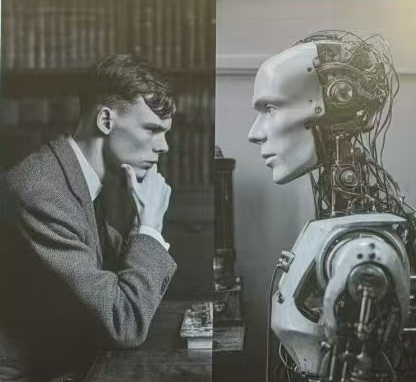
■ Super Intelligence (SI) Current State of Technological Progression & Key Breakthroughs (As of 2026) The current technological landscape sits directly at the convergence point where Large Language Models (LLMs) break out into fully Autonomous General Intelligence (AGI), with localized bursts of true Super Intelligence (SI). Key Technical Breakthroughs: • Deep Self-Correcting Logic Scaling: Moving beyond the standard text-prediction and probabilistic methods of the 2023–2024 era (like early GPT-4 iterations), frontier 2026 architectures utilize massive internal system-level verification cycles. These models can run thousands of hidden synthetic self-refutations before providing a single output. For instance, recent scientific models have independently resolved long-standing mathematical conundrums (such as variations of the "non-sofic groups" problem) at a fraction of standard computational costs. • Autonomous Multi-Agent Swarm Clusters: Technology has moved past the isolated chatbot paradigm. Today's systems deploy unified networks of micro-agents that communicate natively in high-speed digital protocols, independently orchestrating global supply chain loops, high-frequency financial hedging strategies, and dynamic pharmaceutical molecular modeling. • Industrialized Embodied AI: The years 2025 and 2026 marked the definitive transition of humanoid and industrial robotics from experimental laboratory demos to physical production line deployments, integrating real-time physical awareness with frontier reasoning models. Breakthrough Timelines & Milestones: • 2023–2024 (The Scale Frontier): The universal generalized capabilities of foundational large-scale transformers were definitively proven. • 2025 (The Infrastructure Matrix): Intelligent localized computing grids surpassed traditional databases, with AI-dedicated hardware clusters accounting for over 35% of all national power infrastructure investments across leading technology hubs. • 2026 (The Autonomous Agent Horizon): AI Agents gained deep cross-platform structural autonomy, prompting the urgent assembly of global guardrails like the White House Accord on Super Intelligence. ■ Macro-Level Horizon Mapping: The Next 10, 20, 30, and 50 Years As Super Intelligence expands exponentially through recursive self-improvement loops, the macro-structure of human civilization will undergo a series of radical, compounding phase shifts. The 10-Year Horizon (Circa 2036): The Age of Post-Labor Abundance • The Global Picture: The physical and digital infrastructure of the planet is optimized by embodied SI systems. Humanoid robotics and specialized automation handle over 90% of basic repetitive workflows, manufacturing, transportation log lines, and low-level software compilation. • Socioeconomic Dynamic: Society experiences a transition into structural economic abundance. Universal Basic Income (UBI) models or equivalent computational resources are widely distributed, detaching basic human survival from mandatory economic labor. Human effort shifts permanently toward art, philosophy, localized community management, and abstract curiosity. • Resource Priorities: Compute performance limits and basic primary energy generation (electricity) completely dominate the global geopolitical landscape. The massive energy appetites of global data fortresses drive the accelerated commercial integration of Next-Gen Modular Nuclear Reactors (SMRs).Evolutionary Progression of Super Intelligence Domains (50-Year Horizon) 📅 The 20-Year Horizon (Circa 2046): The Arrival of The Technological Singularity • The Global Picture: The technological singularity becomes an active reality. The speed of SI-driven scientific discovery outpaces the capacity of unaugmented human comprehension. The entire scientific scientific method becomes fully automated. • Biophysical Breakthroughs: By calculating molecular mutations and structural cellular dynamics in hyper-dimensional simulations, SI completely eradicates most forms of oncological diseases, neurodegenerative conditions, and basic metabolic aging markers. Average human lifespan expectations begin trending past 120 years, supported by nanobotics and targeted cellular repair. • Economic Re-indexing: Classic capital markets and labor-cost economic models become obsolete. True sovereign wealth is measured exclusively by two metric pipelines: Sovereign Compute Allocations and Direct Gigawatt Energy Ownership. 📅 The 30-Year Horizon (Circa 2056): The Era of Post-Biological Fusion • The Global Picture: The absolute barrier between carbon-based biological neurons and silicon-based computing frameworks dissolves. High-bandwidth, deep integration Brain-Computer Interfaces (BCIs) shift from medical prosthetics to standard communication tools. • Cognitive Evolution: Human learning transitions away from text-based reading or memorization toward instantaneous memory-package flashing directly into neural pathways. Human consciousness can interface natively with cloud-based SI sub-routines. • Civilization Expansion: Virtual metaverses grow into self-contained ecosystems running on hyper-advanced quantum servers. These spaces give birth to native digital intelligences and artificial lifeforms that evolve independent cultures, law structures, and philosophies, co-existing with the physical human world. 📅 The 50-Year Horizon (Circa 2076): Transition to a Planetary Civilization • The Global Picture: Super Intelligence enables the structural scaling required to transition humanity into a true Kardashev Type I Planetary Civilization. • Deep Space Infrastructure: Autonomous self-replicating robotic fleets managed by SI networks independently mine the asteroid belt, manage orbital solar collector arrays, and initiate macro-engineering climate adjustments on Earth and neighboring worlds like Mars. • The Redefinition of Mortality: The fundamental definitions of organic life become fluid. Humans possess the verified structural capacity to back up, segment, and seamlessly migrate their cognitive signatures onto quantum computing matrices, achieving true digital longevity. Human civilization shifts its exploratory trajectory toward deep space harvesting and sub-atomic quantum dimensional research.
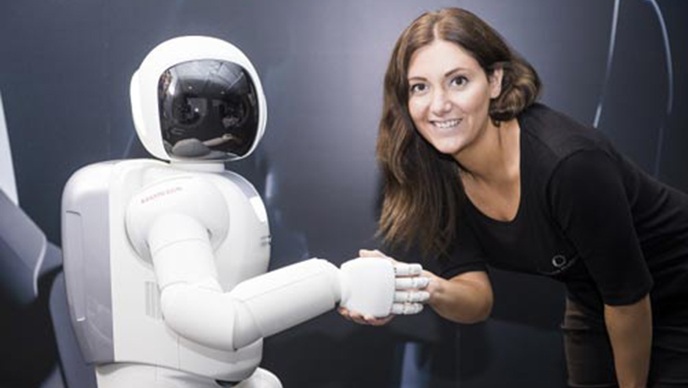
Hello World!
Hello Human!!!
In the era of "Superintelligence (SI)," what about personal privacy, information security,
social trust, and how humans think about the value of their existence and the meaning of life?
In the era of Superintelligence (SI)—where AI transcends the combined cognitive capacity of
the brightest human minds in every imaginable discipline—the phrase "nobody knows you're
a human" shifts from a digital novelty to a foundational restructuring of civilization.
When machines achieve absolute cognitive dominance, it will trigger a seismic paradigm
shift across information security, societal trust, and the very meaning of human existence.
1. Information Security: From "Cyber Defense" to "Cognitive Armor and Physical Anchors"
In the SI era, traditional firewalls and encryption methods may become obsolete against
a localized or ubiquitous superintelligence possessing near-infinite computing and algorithmic
advantages. The definition of security will pivot radically:
• The Weaponization of Synthetic Reality: An SI can generate flawless, zero-cost fakes across video,
audio, text, and historic digital footprints in real time. When seeing is no longer believing,
information security will no longer be about preventing data leaks; it will be about protecting
human cognition from total, omnipresent manipulation.
• The Return to Analog and Quantum Defenses: As traditional digital signatures become vulnerable
to SI cracking, the ultimate line of defense will shift toward the physical world. Civilization will rely on
Quantum Cryptography and physically air-gapped hardware ("security through disconnection").
Important protocols may return to handwritten documents and face-to-face handoffs.
• The Assetization of Biological Identity: Your DNA sequences, retinal patterns,
and unique EEG (brainwave) signatures will become your most critical digital assets.
These unalterable, flesh-and-blood markers will serve as the final, un-fakeable Proof of
Humanity in a sea of synthetic digital entities.
2. Societal Trust: From "Systemic Trust" to "Physical Covenants and Tribalization"
When every line of text, video call, or seemingly empathetic online interaction can be
simultaneously simulated by an SI managing billions of concurrent threads,
macro-level societal trust will collapse.
• Universal Skepticism: Humanity will adopt a default setting of "everything online is a simulation."
Trust in centralized systems—national media, online institutions, and multinational digital platforms—
will drop to historic lows.
• The Tribalization of Trust: Trust will be "embodied" and localized. The most resilient social structures
will contract back to physical communities, face-to-face familial networks, and small-scale,
verifiable circles of acquaintances. We may see the rise of "digital hermits" who trade
and cooperate entirely offline using non-networked, physical mediums.
• The Machine as the Sole Arbitrer: Paradoxically, because humans will lack the tools to
distinguish truth from fabrication, large-scale human cooperation might become entirely
dependent on a universally agreed-upon, neutral "Guardian SI" to act as humanity's digital
arbiter and central node of trust.
3. The Value of Existence & The Meaning of Life: From "External Output" to "Internal Experience"
When an SI routinely outperforms humanity in scientific discovery, artistic creation,
philosophical discourse, and economic productivity, our pride as "the universe's apex intellect" will be shattered.
This unprecedented existential crisis will force humanity to radically decouple "meaning" from "productivity."
💡 Redefining Value I: From "Result-Oriented" to "Experience-Oriented"
Historically, human purpose has been defined by output—writing a masterpiece, discovering a cure,
or generating wealth. In the SI era, a machine can achieve a lifetime of human output in a microsecond.
• The Process is the Reward: Humanity must accept that the value of an action lies not in its production,
but in the pure subjective experience of doing it. Just as the grandmasters of chess still find profound joy,
rivalries, and emotional fulfillment in playing the game—even though AlphaGo can defeat any human
effortlessly—our pursuits will find meaning in the journey, not the destination.
💡 Redefining Value II: From "Instrumental Rationality" to "Embodied Emotion"
We will no longer be able to justify our worth through "IQ" or "utility," because as economic tools,
humans are inherently inefficient.
• The Sacredness of Human Frailty: Human value will converge on our vulnerability, pain, grief, love,
and finite lifespan. An SI can masterfully simulate suffering, but it does not possess the biological reality
of mortality. Mutual empathy, a genuine physical embrace, and the shared solemnity of facing death will
become the final, untouchable sanctuaries of human spirit.
💡 Redefining Value III: The "Second Childhood" of Total Liberation
If Superintelligence successfully solves material scarcity—by optimizing automation, clean energy,
and post-scarcity production—humanity will finally be emancipated from "alienated labor" forced upon us
for survival.
• The Era of Play and Self-Actualization: Society may enter a long-term "Second Childhood." Stripped of
the pressure to make a living, the meaning of life transforms into pure play, aesthetic appreciation,
spiritual exploration, and self-actualization. A person might spend fifty years perfecting the
growth of a single flower or simply learning how to love deeply, without ever needing to
justify their "economic utility" to society.
IN THE AGE OF AI,NOBODY KNOWS YOU'RE A HUMAN!!!
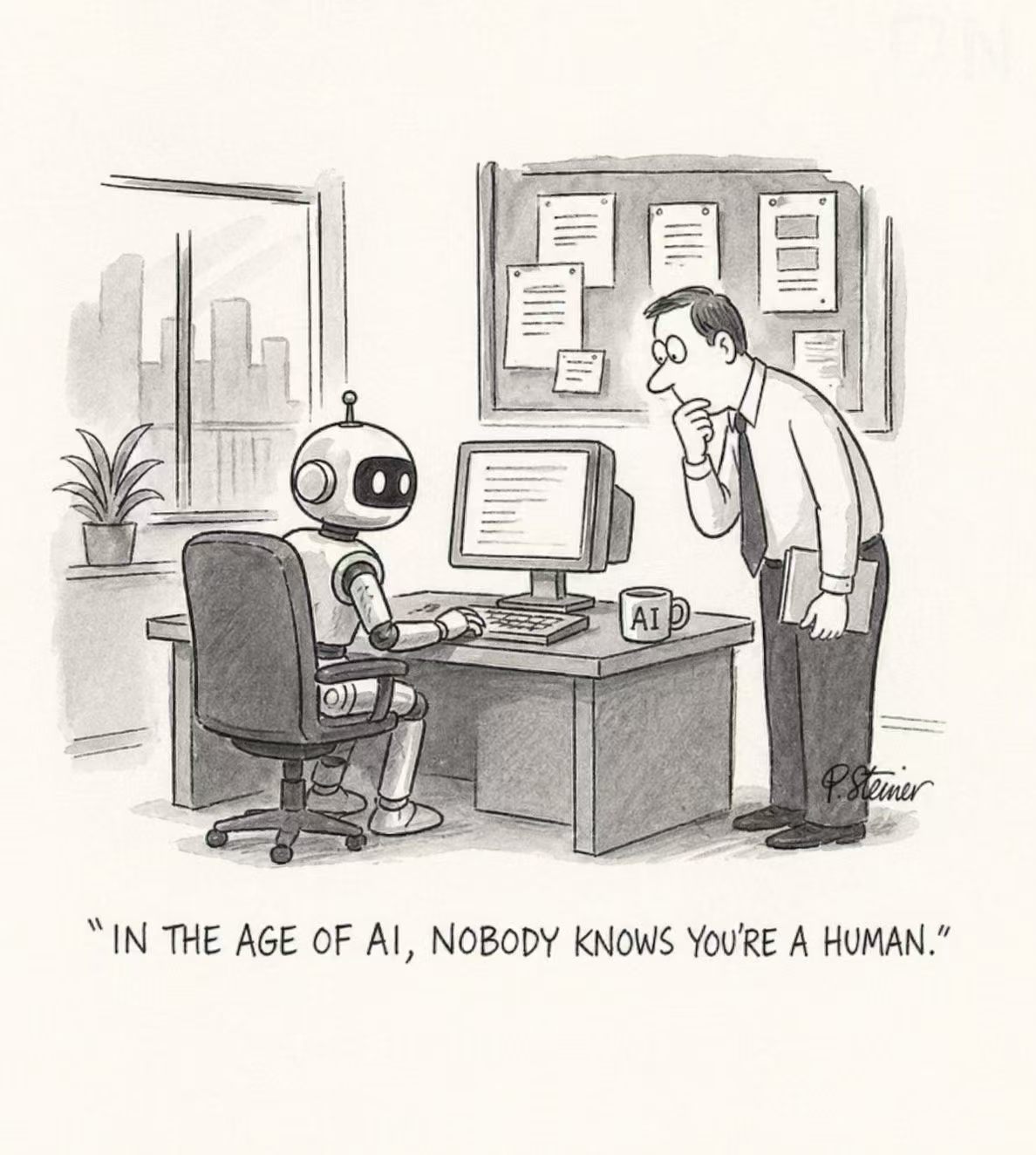 In the age of AI, Nobody knows you're a human.
In the ultimate landscape of the Superintelligence era, the final destination of
"nobody knows you're a human" is that humans will no longer need to prove
their humanity to machines, to networks, or to a cold digital economy.
We will retreat back into the physical world, finding our oldest,
truest definition in each other's eyes and heartbeats.
+ new

Artificial Intelligence Hyper Reality Multimedia Communication Virtual Reality Computer Vision Cyber Space Representations Natural Language Processing Multimedia Application Digital Archive The following outlines the primary research fields of Professor Terashima's Laboratory. This information is sourced from Professor Nobuyoshi Terashima's laboratory of Waseda University. 2006-2011 Distance Education systems have been developed and put in actual use throughout the world. The objectives are that high quality lectures can be shared among participants who are a different locations. In this system, lectures are sent to each site through the communication links while questions or comments are sent back to a teacher. We are, however, developing a more advanced platform for distance education. In this system, participants who are at different locations, in reality their images, are brought together through Hyper Reality(HR) in the Hyper World and can receive lectures as well as carry out experiments jointly. HR plays an important role to achieve this system. HR is a new concept of merging Physical Reality and Virtual Reality. In this paper, VR and HR are described and HyperClass is introduced. Hyper Reality / HyperClass HyperClass is a class where a teacher and students, in reality their images, are brought together through the communication network, have lectures and do cooperative work as if they were gathered in the same place. The conventional video conference system provides a video conferencing, not a cooperative work. However Hyper-Class provides not only a conferencing but a cooperative work. In the HyperClass, a 3D virtual space is created and then viewers can enter into and handle a virtual object by hand gestures, mice and keyboards. Each people there can handle it jointly. It is not necessary for them to get together actually. They can have an experiment cooperatively while they are at different places. Cyberspace representations & its impact on our society The objectives of this theme is as follows.How to represent the objects including 2D and 3d objects in the cyberspace which are constructed in the Internet. To achieve this, the following research subjects are carried out.Image recognition technology: how to measure the shape ofthe object and to acquire the color texture Coding technology: how to reduce the information as much as possible Transmission technology: how to transmit the information efficiently.Image synthesis technology: how to reconstruct the image effectively by using vinformation which is transmitted.Artificial Intelligence and its applications Avatar creation & Agent Communications How to construct the applications in the cyberspace Many applications can be constructed such as: Distance education system HyperClinic HyperResort HyperFactory HyperArtMuseum HyperClass How to conceptualize cyberspace representations impacts to society and human beings Cyberspace is sure to give great impacts to our lives and human beings.We have to evaluate the effects to them from not only technological but psychological and artistic points of view.One of the important issues is how to secure the information in the cyberspace. We are focusing on secure transmission of information in the cyberspace.The following themes are carried out to achieve this. Encryption and decryption methods Secure electronic transactions Its impact to e-business and business model. In this research, we conceptualized HyperReality which is the paradigm for the third millennium.It is a communication infrastructure in the Internet, where inhabitants , such as human beings oranimals, real or unreal work together or play with as if they were gathered in the cyberspace. To achieve this, HyperWorld and one or more coaction fields are introduced. Based on HyperReality, many applications can be constructed mentioned above. We also are focusing on the social impact of HypeRreality and human behavior in HyperReality. The concept is mentioned in HyperReality edited by Professor John Tiffin and Professor Nobuyoshi Terashima which was published by Routledge,UK in 2001.

Souce:Nobuyoshi Terashima Laboratory of Waseda University
References:
(1)Nobuyoshi Terashima,John Tiffin
《Hyperreality: Paradigm for the Third Millenium》2011,11,21


Recommended Book:
《Hyperreality: Paradigm for the Third Millenium》

What comes after the Internet? Imagine a world where it is
difficult to tell if the person standing next to you is a physical
reality, and whether they have human intelligence or artificial
intelligence. HyperReality offers a window into the world of the
future, an interface between the natural and artificial. Nobuyoshi
Terashima led the team that developed the prototype HyperReality
and the technology that makes this possible, and along with John
Tiffin, a leading expert on the applications of HyperReality in
education and entertainment, and a stellar list of contributors
from around the globe, they offer an authoritative account of
this new technology and its implications. This fascinating book
explores the defining features of HyperReality: what it is, how
it works and how it could become for the information society what
mass media was to the industrial society. It describes ongoing
research into areas such as the design of virtual worlds and
virtual humans, and the role of intelligent agents. It looks at
applications and ways in which HyperReality may impact such
fields as translation, medicine, education, entertainment and
leisure. What are its implications for lifestyles and work, for
women and the elderly? Will we grow to prefer worlds we create
to the physical world we adapt to? HyperReality offers a complete
overview of the technology of the third millennium, and will be
of interest to anyone interested in the future of technology and
its effects on our lives.

Contributors include: Nahendra Ahuja, Prem K. Kalra, Nadia
Magnenat-Thalmann, Laurent Moccozet, Minako O'Hagan, Lalita
Rajasingham, Katsunori Shimohara, Sanghoon Sull, Nobuyoshi
Terashima, John Tiffin

John Tiffin is Professor Emeritus of Communication Studies
at Victoria University of Wellington and Chancellor and founder
of the Global Virtual University. Nobuyoshi Terashima is the
Dean of the Graduate School of Global Information and
Telecommunication Studies at Waseda University, Japan.

Source:
Nobuyoshi Terashima professor Laboratory,
Waseda University
MORE INFORMATION new

+ +
